Compact70 specs
| Brand | Santa Fe |
|---|---|
| Capacity (AHAM, 80°F/60% RH) | 70 pints/day |
| Max coverage | 2,200 sq ft |
| Drainage | Gravity drain (8-ft hose included) |
| Dimensions | 21" L x 12" W x 12" H |
| Weight | 55 lbs |
| Power draw | 5.1A |
| Airflow | 150 CFM |
| Noise | 55 dBA |
| Filter | MERV-13 |
| Energy Star | No |
| Warranty | 6 years |
| Price tier | $$ Mid-range ($1,000–$2,000). See Amazon for today's price. |
- 70 pints/day is rated at 80°F/60% RH; at a more crawl-space-like 65°F/60% RH it removes about 43.7 pints/day.
Specs are compiled from manufacturer listings and may change between production runs. Confirm on the retailer page before buying.
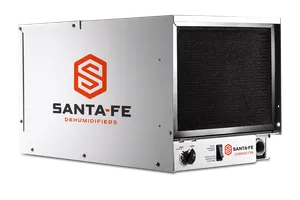
The Santa Fe Compact70 is the crawl space specialist’s dehumidifier: a 70-pint (AHAM) unit built in Madison, Wisconsin with a steel cabinet, a MERV-13 filter as standard, and a 12-inch profile designed to slip between floor joists. Spec sheets show 70 pints per day at the AHAM standard of 80°F/60% RH, covering up to 2,200 square feet of crawl space. It isn’t the cheapest 70-pint machine — retail listings show ~$1,300–1,450 — but it’s the best build quality pick in the category, and the low height opens up installations that taller units simply can’t serve.
Capacity
The headline number is honest: 70 pints/day at AHAM conditions (80°F/60% RH). But the spec sheet tells a more complete story, and it’s one buyers should read carefully: at 65°F/60% RH — temperatures your crawl space will actually see in shoulder seasons and winter — capacity drops to roughly 43.7 pints/day. That’s the physics of refrigeration dehumidification, not a defect, and every unit in this class degrades in the cold. It just means you should size on the cold-weather figure, not the headline.
If your crawl space is at the top of the 2,200 sq ft coverage range and runs cool, the honest math says the Compact70 may come up short in the worst months — that’s the argument for stepping up to the Advance90. For smaller or well-sealed spaces, 70 AHAM pints is plenty, and our AHAM vs saturation guide explains exactly how to compare these numbers against competitors’ headline figures.
Who the Santa Fe Compact70 is for (and who should skip it)
Buy it if your crawl space is low — the 12” x 12” x 21” form factor and rotatable exhaust (horizontal or vertical discharge) make it the installer’s choice for tight, awkward spaces. Buy it if build quality matters: a steel cabinet, US manufacture, MERV-13 filtration standard, and a 6-year warranty make it the sturdiest unit in its class. The MERV-13 stock filter alone is worth a callout — it’s the best stock filter on any crawl space dehumidifier we track, and it means cleaner air without buying an upgrade on day one.
Skip it if you want modern controls — the humidity control is an old-school knob, which some buyers find dated next to digital panels (though owners report the knob has exactly one job and does it reliably). Skip it if energy certification is on your checklist: there’s no Energy Star rating, which matters for some rebate programs. And skip it if your space is at the large end and runs cold — the capacity drop at 65°F means marginal sizing in those conditions.
Installation and drainage
The Compact70 was designed by people who have crawled under houses. The 12-inch height fits between floor joists, the rotatable exhaust lets you discharge air horizontally or vertically to suit the space, and the whole unit weighs just 55 lbs — the lightest in this roundup, which matters when you’re hauling it through an access hatch. At 150 CFM it’s the lowest airflow of the three units here, which is the trade-off for the compact form: it’s moving less air per hour, so placement and air circulation strategy matter more.
Drainage is gravity-only — the Compact70 ships with an 8-foot drain hose and no internal pump. You’ll need a drain point at or below the unit’s outlet height, routed to daylight or a condensate line. If gravity drainage isn’t practical in your space, you’ll need an external condensate pump; that’s the one convenience where this unit concedes to pump-equipped competitors.
Noise, energy and running costs
Spec sheets show 55 dBA — the quietest of the three units in this review set, and quiet enough that most owners never notice it through the floor. Electrical draw is 5.1 amps, which is modest for a 70-pint unit, and owners report reasonable power bills for what it does. Still, without an Energy Star label there’s no independently certified efficiency figure to quote — plug your rate into the operating cost calculator for an honest estimate rather than trusting vibes.
Maintenance
Maintenance is where the MERV-13 filter pays dividends. It’s a real pleated filter, not a mesh screen, so it captures fine dust and allergens — and in a crawl space, the filter takes abuse. Owners report checking it quarterly and replacing as needed; replacement filters are a routine purchase. With no pump and no bucket, the mechanical side is minimal: keep the coil free of debris, verify the gravity drain hose stays clear and sloped, and the steel cabinet takes care of the rest. The 6-year warranty backs the longevity story — this is a unit built to be bought once.
The Compact70 is our best build quality pick: nothing else at this price fits a 12-inch crawl space while carrying a steel cabinet, MERV-13 filtration, and a 6-year warranty from a US manufacturer. Go in knowing the trade-offs — knob controls, no Energy Star label, modest 150 CFM, and a cold-weather capacity dip that demands conservative sizing — and it’s the most confidently durable 70-pint unit you can buy. Check the current price on Amazon.
Featured in our guides
- The 7 Best Whole-House Dehumidifiers of 2026: Honest Rankings by Capacity, Value & Use Case
- AprilAire vs AlorAir vs Santa Fe: Which Whole-House Dehumidifier Brand Wins?
- Crawl Space Dehumidifier Guide: Encapsulation, Drainage & the Best Units for 2026
- Crawl Space Dehumidifier With Pump: Why the Pump Matters (2026)